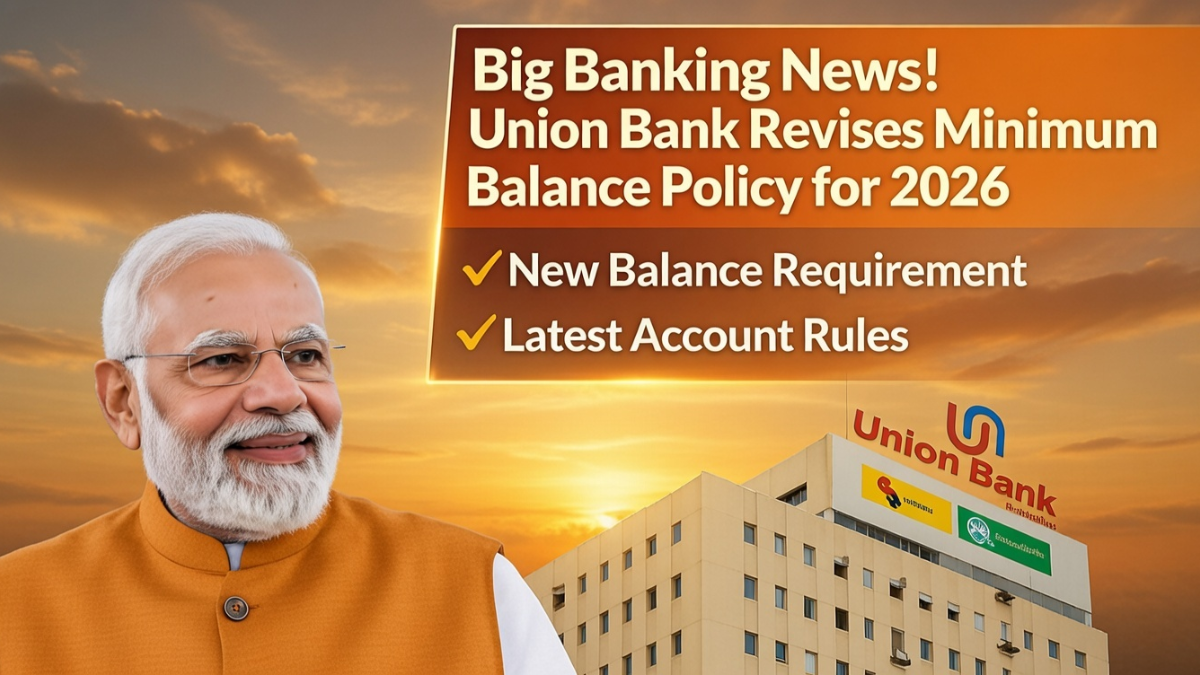
Bank customers across India are reacting after a major update from Union Bank regarding its minimum balance rules for 2026. The revised policy has sparked concern among savings account holders who fear unexpected penalties if they fail to maintain the required average monthly balance.
If you have an account with Union Bank, this update could directly affect your monthly banking costs, account management strategy, and even your long-term savings planning.
What Has Changed in the 2026 Minimum Balance Policy?
Union Bank has revised the minimum average balance requirement across select savings account categories. The change is part of a broader restructuring aimed at aligning operational costs, digital expansion, and branch network rationalization.
The new policy adjusts balance thresholds based on account type and branch location category such as metro, urban, semi-urban, and rural. Customers who do not maintain the updated average balance may face revised penalty charges.
The move reflects a growing trend in the banking sector where institutions are optimizing fee structures to support digital banking infrastructure and service upgrades.
Why Union Bank Introduced the Revision
The decision is reportedly linked to rising operational expenses, technology investments, and regulatory compliance requirements. As banks continue to enhance mobile banking platforms, cybersecurity systems, and AI-driven services, maintaining cost efficiency has become essential.
Union Bank’s 2026 update aims to balance customer service improvements with sustainable revenue models. While some customers may experience higher minimum balance requirements, others could benefit from improved digital features and faster service.
Who Will Be Most Affected?
The impact largely depends on the type of savings account you hold. Regular savings account holders in metro and urban branches are more likely to see noticeable changes compared to rural account holders.
Customers who consistently maintain higher balances may not feel any difference. However, individuals who operate with low balances or frequently dip below minimum requirements could see increased penalty deductions.
Senior citizens, salary account holders, and certain government scheme-linked accounts may continue to enjoy exemptions, depending on the specific account category.
Penalty Charges and Compliance Details
Under the revised structure, penalty charges for non-maintenance of average monthly balance may vary based on the shortfall amount. The bigger the gap between required and maintained balance, the higher the potential charge.
Banks typically calculate the average monthly balance by adding the closing balance of each day in a month and dividing it by the number of days. Customers who miscalculate or assume a fixed balance requirement could unintentionally trigger penalties.
It is crucial to monitor your account regularly through mobile banking apps or SMS alerts to avoid unnecessary deductions.
How Customers Can Avoid Penalties
Avoiding charges under the 2026 policy update is possible with simple adjustments:
- Maintain the updated average monthly balance consistently
- Convert to a zero-balance salary or basic savings account if eligible
- Set up balance alerts through mobile banking
- Review account category and switch if needed
A proactive approach can help prevent small charges from accumulating over time.
What This Means for the Banking Sector in 2026
Union Bank’s decision signals a broader trend of tightening compliance and structured fee management in the banking industry. As digital adoption increases, banks are revisiting legacy fee structures to remain competitive while maintaining profitability.
Customers can expect more transparency but also stricter enforcement of balance rules. The era of casual balance maintenance is fading, and financial discipline is becoming more important than ever.
Conclusion
The 2026 minimum balance revision by Union Bank is not just a minor rule change. It could directly impact your monthly finances if you are unaware of the updated thresholds. While the policy supports operational sustainability and digital expansion, customers must stay alert to avoid penalty charges.
Understanding your account type, monitoring your balance, and adjusting financial habits can help you stay ahead of the change. In a year where banking regulations are tightening, awareness is your strongest financial protection.
Disclaimer: This article is for informational purposes only. Customers should verify the latest minimum balance requirements directly with their bank branch or official communication channels.
“), i.text = “window._taboola = window._taboola || [];_taboola.push({mode:’alternating-thumbnails-a’, container:’taboola-below-article-thumbnails’, placement:’Below Article Thumbnails’, target_type: ‘mix’});”, n.appendChild(l), n.appendChild(i), e(n, t) } Array.prototype.filter || (Array.prototype.filter = function(e, t) { if (“function” != typeof e) throw TypeError(); let n = []; for (let l = 0, i = this.length >>> 0; l < i; l += 1) if (l in this) { let r = this[l]; e.call(t, r, l, this) && n.push(r) } return n }), window.insertAfter = e, window.getElementByXPath = t, window.injectWidgetByXpath = function e(l) { let i = t(l) || document.getElementById(“tbdefault”); i && n(i) }, window.injectWidgetByMarker = function e(t) { let l = document.getElementById(t); l && l.parentNode && n(l.parentNode) }, window.innerInject = n }();injectWidgetByMarker(‘tbmarker’);