India’s electric passenger vehicle (EV) market witnessed a breakout year in FY2026, firmly establishing itself as one of the fastest-growing segments in the automotive industry. The automotive landscape is undergoing a seismic shift as electric mobility moves from the periphery to the mainstream, reaching a total market volume of 2,20,105 units (dispatch figures) in FY2026.
As the dust settles on the fiscal year, a fascinating hierarchy has emerged that challenges everything we thought we knew about the Indian consumer. Who is actually winning the race for India’s electric future?
OEM Share in Electric Car Market – FY2026
OEM
Sales
Share
Tata Motors
85,405
~38.8%
MG Motor
62,591
~28.4%
Mahindra
54,626
~24.8%
Hyundai
5,748
~2.6%
Kia
4,485
~2.0%
Maruti Suzuki
3,652
~1.7%
Others
~600
~0.3%
-
Tata demonstrates its strength via a “market saturation” strategy, ensuring there is an electric option for every demographic, from the entry-level hatchback to the premium SUV. Tata’s dominance is best reflected in the leaderboard: they hold a staggering 30% of the slots in the Top 20 list, with six unique models (Nexon, Harrier, Punch, Tiago, Curvv, and Tigor). The collective strength of their top five models—Nexon (#2), Harrier (#4), Punch (#5), Tiago (#7), and Curvv (#10)—amounts to a massive 85,565 units.
-
MG’s three-pronged attack (Windsor, Comet, ZS) effectively captures nearly 30% of the total market volume, proving that a tech-first ecosystem can successfully challenge legacy giants.
-
Mahindra’s FY2026 data reveals a successful “clean-sheet” design strategy that has fundamentally revitalized the brand’s electric prospects. There is a visible, performance-based divide between their purpose-built EV lines and their legacy-frame models. The market is clearly rewarding Mahindra’s dedicated platforms.
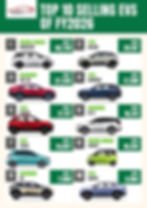
Top 10 Selling Electric Cars of FY2026:
-
Windsor has emerged as the definitive disruptor of the year, securing the #1 spot with a commanding lead. Accounting for over one-fifth of the entire EV market, Windsor’s success is a surprising disruption to the traditional order.
-
The Nexon EV ranked second in the list and continues to be a benchmark in the mass EV space, backed by Tata’s strong ecosystem and widespread acceptance.
-
Mahindra’s aggressive EV push paid off with the XEV 9e, which quickly became one of the most popular new-age electric SUVs with sales of 27,336 units in FY2026.
-
The Harrier EV strengthened Tata’s presence in the premium SUV segment and ranked fourth with dispatches of 17,590 units in FY2026, attracting buyers looking for size, performance, and brand trust.
-
A key driver of affordable EV adoption, the Punch EV brought electric mobility closer to first-time buyers and sold 17,117 units last FY.
Modelwise Sales of Electric Passenger Cars in FY2026:
Rank
OEM
Model
FY2026 Nos
Contribution%
1
Morris Garage
Windsor
46,720
21.2%
2
Tata
Nexon
29,197
13.3%
3
Mahindra
XEV 9e
27,336
12.4%
4
Tata
Harrier
17,590
8.0%
5
Tata
Punch
17,117
7.8%
6
Mahindra
BE 6
16,313
7.4%
7
Tata
Tiago
14,697
6.7%
8
Morris Garage
Comet
10,292
4.7%
9
Mahindra
9S
7,896
3.6%
10
Tata
Curvv
6,964
3.2%
11
Morris Garage
ZS EV
5,579
2.5%
12
Hyundai
Creta
5,563
2.5%
13
Kia
Carens
4,483
2.0%
14
Maruti Suzuki
eVitara
3,652
1.7%
15
Tata
Tigor
2,840
1.3%
16
Mahindra
XUV 400
2,400
1.1%
17
Mahindra
XUV 3X0
681
0.3%
18
Citroen
Ë C3
598
0.3%
19
Hyundai
IONIQ 5
185
0.1%
20
Kia
EV9
2
0.0%
TOTAL
2,20,105
FY2026 can be termed the “breakthrough year” for electric cars in India. With sales nearly doubling year-on-year and multiple strong product successes, the segment has transitioned from early adoption to early mass adoption.
However, the next phase of growth will depend on affordability, infrastructure, and policy stability. If these align, India is well on track to become one of the world’s largest EV markets in the coming decade.
Visual Snapshot of the EV sales in FY2026: